

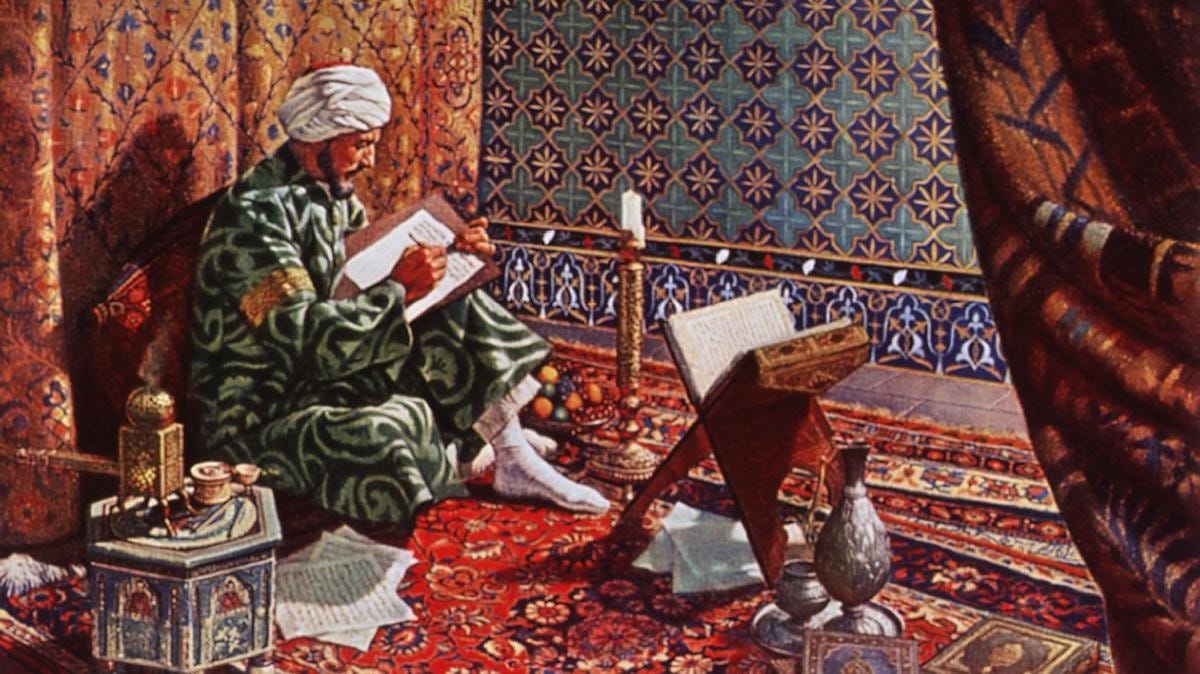
When Islamic Spain began losing its territories to Christians after centuries of rule that started in 711, Muslim poets of Al-Andalus wrote elegiac poetry, lamenting the loss of a once-flourishing civilisation and all the beauty it had birthed in the Iberian Peninsula. The most famous of those works is the Ritha’ al-Andalus (Lament for the Fall of Seville), written in 1267 by Abu al-Baqa’ al-Rundi (d. 1285). In his devastating Arabic poem, al-Rundi mourns the loss of Al-Andalus as well as the decline of Islamic unity, the apathy of Muslim rulers, and the loss of a golden age of civilisation. He masterfully invokes history, theology, and raw human emotion to stir the sleeping conscience of the Muslim world.
Al-Rundi sets the stage with his widely cited opening couplet thus:
لكل شيءٍ إذا ما تمّ نقصانُ
فلا يُغرّ بطيب العيش إنسانُEverything declines after reaching perfection,
So let no man be deceived by the splendour of life.
Later in the poem, he writes a couplet that could just as easily describe the last two years:
كم يستغيثُ بنا المُستضعفونَ وهم
قتلى وأسرى، فما يهتزّ إنسانُ!How many oppressed ones cry out to us —
Slain and captive — yet no one stirs!
And again:
يا ربّ أمٍ وطفلٍ حيلَ بينهما
كما تُفرَّقُ أرواحٌ وأبدانُO Lord, how many mothers and children were torn apart,
As if their souls and bodies had been severed.
Six centuries after al-Rundi, as Muslims of the Indian subcontinent faced a bleak future following the failed First War of Independence against the British in 1857, Allama Altaf Hussain Hali (d. 1914) wrote a stunning elegy of his own, lamenting the status of his fellow countrymen and the ummah as a whole. Written in 1879 and titled Musaddas‑e‑Madd‑o‑Jazr‑e‑Islam (A Musaddas on the Rise and Fall of Islam), Hali’s book-length poem starts in the darkness of jahiliyyah (pre-Islamic Arabia), captures the light of revelation as it was bestowed upon the Prophet (peace be upon him), traces its manifestation in the spectacular civilisational achievements wherever Islam spread, and ultimately culminates in the demise of that glorious tradition.
Written as a musaddas — a genre of Urdu poetry composed of six-line stanzas following an AAAABB rhyme scheme — Hali starts with a ruba’i (quatrain) that gets straight to the point:
پستی کا کوئی حد سے گزرنا دیکھے
اسلام کا گر کر نہ اُبھرنا دیکھے
مانے نہ کبھی مدّ ہے ہر جَزر کے بعد
دریا کا ہمارے جو اُترنا دیکھےNo one has seen degradation cross all limits,
Until they’ve seen Islam set without a rise.
No one would believe crests follow troughs,
Until they saw our unending fall.
Within three decades of Hali, Allama Muhammad Iqbal composed a shorter work in the same vein. First recited in 1909 — when the condition of Muslims across the globe was steadily worsening — Iqbal’s Shikwa (The Complaint) is arguably the most famous work of Urdu poetry.
Unlike the other two works, Iqbal’s complaint is directly addressed to God. In this masterful work, Iqbal first apologises to God for his audacity in complaining to Him, and then recounts the many times Muslims upheld God’s commandments and spread His message far and wide. Then he gets to the heart of the poem: why are the Muslims all over the world enduring such a harsh fate, and more daringly, why have You forsaken us?
In one of the most audacious couplets of the poem, Iqbal writes:
کبھی ہم سے، کبھی غیروں سے شناسائی ہے
بات کہنے کی نہیں، تُو بھی تو ہرجائی ہےMust You too play the fickle flirt with us, with others, day by day,
We cannot help the sinful thought which shame forbids our lips to say.
The youngest of these elegies — Iqbal’s — is over a century old, but all capture the dread Muslims felt at the time they were written: the incessant degradation of a once-glorious past, the sense of its impending collapse, the fear of an uncertain future, and the lack of any positive sign that the rut would be reversed.
In the century since Shikwa, the decline has only deepened — steadily and rapidly.
While Iqbal saw the end of the Islamic caliphate during his lifetime, having passed away in 1938, he never got to witness the fall of Al-Quds, the wholesale slaughter during the partition of India, or the subjugation of Muslim states to foreign regimes. Nor did he live to see the ever-expanding boundaries of the Jewish state, its incessant killing of innocents in and around the land it occupies, the sanctioned murder of millions in Iraq, the genocide of Bosnian Muslims, the ethnic cleansing of the Rohingya in Myanmar, the total destruction of numerous Muslim countries and cultures, or the ongoing genocide in Gaza today. He was spared the heartbreak of witnessing the Muslim world’s descent into intellectual stagnation, spiritual apathy, and political irrelevance. He never saw how the ummah — for which he wept, prayed, and tirelessly worked to revive — became fragmented by sectarianism, betrayed by its own rulers, and caricatured globally as either victim or villain — with little resistance. He was spared the vision of how the leaders once revered as torchbearers of justice became but hollow echoes, gathering in luxury while the oppressed cried out, unheard.
Indeed, the genius that he was, Iqbal feared these outcomes, but he never saw the full weight of their arrival.
And quite a weight it has been. The last two years, especially, have been bone-crushing, yet incredibly revealing. They have stripped away many a façade, exposing utter moral bankruptcy and vacuity. As mothers and children have been torn apart and the oppressed have cried out in the hope of being relieved of their pain and suffering, a blind eye has been turned; ears have been shut, screams have been ignored, and life has continued as if it were perfectly normal for hundreds of lives to be extinguished daily in the most sadistic ways imaginable.
As if to underline the complete moral decay and apathy of modern Islamic polity, when the Arab and “Islamic” countries recently met to discuss the genocide in Gaza and the attack on Doha, they could not even draft a resolution to boycott the genocidaires, or to boot out the ambassadors of the genocidal entity — let alone formulate a plan to confront the oppressors militarily and relieve the Palestinians of their decades of suffering.
When the besieged, starved, and endlessly bombarded defenceless Palestinians have cried out, “Where are the Arabs? Where are the Muslims?” the ummah has responded with deafening silence. The pharaoh in Egypt hasn’t opened the borders, the normalisers have not shuttered their embassies, and the trading regimes have not stopped the flow of food or fuel to the genocidaires. No attempts to break the siege, no initiatives to arm the resistance, no threat of an armed response. The message is as bleak as it is unmistakable: self-interest has triumphed over religious and moral obligation. The cries of the oppressed carry no weight in a fractured, indifferent ummah.
During his 1931 visit to Palestine, Iqbal composed one of his most profound poems: Zauq-o-Shauq (Ecstasy). In one of the poem’s 31 couplets, Iqbal mourns the absence of courage, resistance, and moral leadership in a world filled with oppression and subjugation, by using the example of the martyrdom of the Prophet’s grandson, Hussain in Karbala. He writes:
قافلۂ حجاز میں ایک حسینؓ بھی نہیں
گرچہ ہے تابدار ابھی گیسوئے دجلہ و فراتThe caravan of Hijaz has not another Hussain amongst it —
Although the tresses of the Tigris and the Euphrates are still as bright as ever.
Indeed, of the 58 “leaders” who spent two days in some of the world’s most luxurious hotels, sipping exotic beverages, not one could claim any proximity to the caravan of Hijaz.
Far from exhibiting spiritual or moral kinship with one of history’s greatest martyrs of justice, the supine show in Doha compels one to wonder whether there were any Muslims in the gathering at all — for, as al-Rundi concludes in Ritha’ al-Andalus:
لمثل هذا يذوب القلبُ من كمدٍ
إن كان في القلب إسلامٌ وإيمانُFor such calamity, the heart melts in sorrow —
If there is any Islam or faith left in the heart.
All my articles and poems will always be free to read, but I really depend on your support to keep writing. If you can, please consider a paid subscription here or on Ko-fi or Patreon. Thank you!
Your writing in this post is as elegant as the poet's, whose most poignant observation for not only the Muslim world, but the world at large is this one:
"the absence of courage, resistance, and moral leadership in a world filled with oppression and subjugation"
This vacuum in true moral leadership sucks the vitality from all of us as we struggle with authoritarianism, imperialism, and frank genocide on two continents. Fighting off despair is a tall order.
From what I can tell, it's the Palestinians that have Islam in their hearts